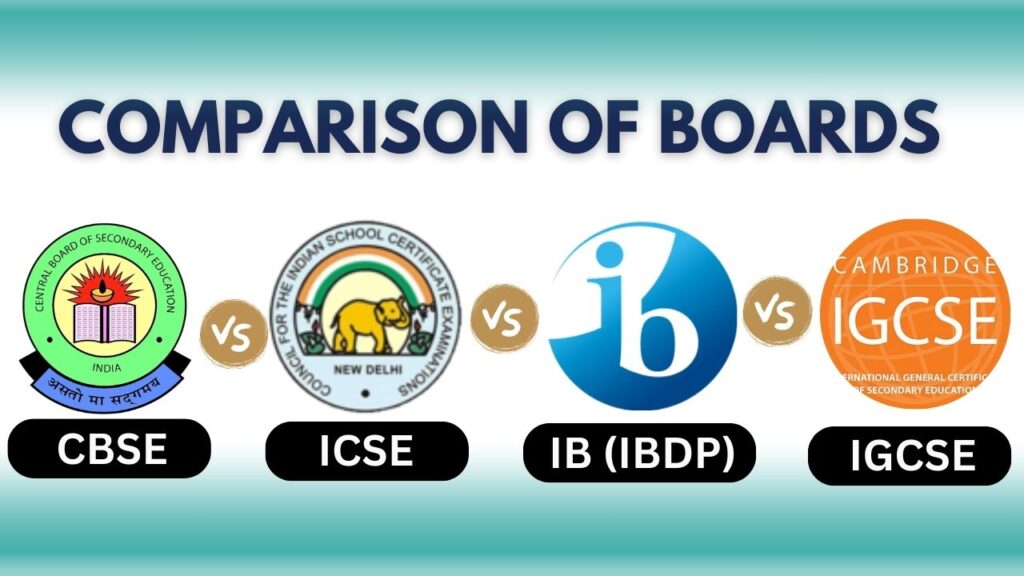
Choosing the right education board is a crucial decision that influences your child’s learning journey, future studies, and career opportunities. In India, parents often grapple with the choice between the Central Board of Secondary Education (CBSE), Council for the Indian School Certificate Examinations (CISCE), International Baccalaureate (IB), and Cambridge Assessment International Education (Cambridge). Each board has its unique approach to education, curriculum, and assessment.
In this blog, we’ll break down these four major education boards and help you make an informed decision.
1. Overview of Each Board
CBSE (Central Board of Secondary Education)
CBSE is the most popular board in India, managed by the Government of India. Known for its standardized curriculum, it focuses on science and math with an application-based learning approach. CBSE schools are widely spread across India, making it a practical choice for students who may relocate frequently.
CISCE (Council for the Indian School Certificate Examinations)
CISCE is a privately managed board known for its focus on a balanced and comprehensive curriculum. Unlike CBSE, CISCE offers an extensive range of subjects, including arts, humanities, and commerce. It is renowned for its emphasis on project work and practical learning.
IB (International Baccalaureate)
IB is an international board that emphasizes global learning and interdisciplinary study. The curriculum is designed to develop critical thinking, research, and holistic development. IB is ideal for students aiming to pursue higher education abroad and who prefer inquiry-based learning.
Cambridge Assessment International Education
Cambridge is part of the University of Cambridge in the UK and offers a flexible, internationally recognized curriculum. It focuses on critical thinking and analytical skills, with programs like the International General Certificate of Secondary Education (IGCSE) and Advanced Level (A-level). It is widely accepted by universities globally.
2. Curriculum Structure
CBSE
The CBSE curriculum is centered around the NCERT textbooks and focuses on science, technology, engineering, and math (STEM) education. Subjects like history, geography, and economics are also part of the curriculum but not given as much emphasis. The teaching approach is theoretical, designed to help students crack competitive exams like JEE and NEET.
CISCE
CISCE offers a broader curriculum, especially in the arts and commerce streams. It encourages students to undertake project work and gives more importance to practicals, which helps in holistic learning. CISCE’s curriculum, especially at the ISC level, is considered more challenging than CBSE due to its depth in subjects.
IB
IB’s curriculum focuses on inquiry-based and research-oriented learning. It is divided into three programs:
- Primary Years Programme (PYP): Focuses on the development of the whole child.
- Middle Years Programme (MYP): Encourages practical connections between subjects and the real world.
- Diploma Programme (DP): Prepares students for university through rigorous study and independent research.
Cambridge
The Cambridge curriculum is known for its flexibility, allowing students to choose subjects based on their strengths and interests. It emphasizes depth in learning and helps develop analytical thinking. The two key programs are the IGCSE (Grade 10) and A-level (Grade 12), both widely accepted globally.
3. Assessment Methodology
CBSE
CBSE exams are conducted at the end of Grades 10 and 12. The exams are largely objective and theoretical, which makes it easier to score well. Internal assessments carry less weight, with a strong focus on the final board exams.
CISCE
CISCE offers a mix of theory and practical assessments. For ICSE (Grade 10), 20% of the total score is based on internal assessments, while for ISC (Grade 12), project work holds substantial importance. This board encourages a balanced assessment approach.
IB
IB’s assessment is continuous and consists of both internal and external evaluations. Students have to complete an Extended Essay, Theory of Knowledge, and Creativity, Activity, Service (CAS) projects. The exams are largely essay-based, requiring critical thinking and application of knowledge.
Cambridge
Cambridge follows a similar approach to IB with both coursework and written exams. Cambridge’s exams are analytical, with a strong focus on developing critical thinking. The final assessment includes a mix of essays, coursework, and practical exams.
4. Grading System
CBSE
CBSE uses a Cumulative Grade Point Average (CGPA) system. Students are graded on a 9-point scale from A1 to E. The system is focused on ranks and percentages, making it easier for Indian universities to assess students.
CISCE
CISCE follows a percentage-based grading system. Students receive grades in the form of percentages, with a pass mark of 35% for ICSE and 40% for ISC. The board emphasizes both internal assessments and final exam performance.
IB
IB uses a 7-point grading system. Students are evaluated on several criteria, including internal assessments and final exams. The overall score is out of 45 points, with additional points for the Extended Essay and Theory of Knowledge.
Cambridge
Cambridge uses grades from A* to E, similar to the UK grading system. The grades are based on a mix of coursework, written exams, and practical assessments, with the emphasis placed on a student’s analytical and critical thinking skills.
5. Recognition and Global Acceptance
CBSE
CBSE is recognized across India and is ideal for students who plan to pursue higher education within India. However, its recognition outside India is limited, particularly in comparison to IB and Cambridge.
CISCE
CISCE is widely accepted in India and a few international universities. It offers a good balance between Indian and international recognition, making it a solid choice for students with diverse career aspirations.
IB
IB is one of the most globally recognized boards. Universities worldwide accept IB scores, making it the best choice for students who aim to study abroad, especially in top-tier institutions.
Cambridge
Cambridge qualifications are recognized in over 160 countries. Its A-levels and IGCSE are valued highly by universities and employers alike, making it a strong contender for international education.
6. Cost and Accessibility
CBSE
CBSE is the most affordable board in terms of tuition fees, with a large number of government and private schools offering it across the country. It is accessible in both urban and rural areas.
CISCE
CISCE is more expensive compared to CBSE and is primarily offered in private schools. It is mostly available in urban areas, and its schools have higher tuition fees.
IB
IB is one of the most expensive boards, offered in premium private schools. The cost of IB education is high due to its international standards and curriculum requirements.
Cambridge
Cambridge is also a high-cost option, primarily offered in international schools in India. The tuition and exam fees are significantly higher compared to CBSE and CISCE, making it accessible mainly to students from higher-income families.
7. Extracurricular and Overall Development
CBSE
CBSE schools often focus more on academics, with limited attention given to extracurricular activities. However, some schools are now integrating sports, arts, and community service into their programs.
CISCE
CISCE promotes extracurricular activities and overall development. Students are encouraged to participate in arts, sports, and community service alongside academics, promoting a well-rounded education.
IB
IB strongly emphasizes holistic development. Through its Creativity, Activity, Service (CAS) program, IB ensures that students engage in extracurriculars as part of their learning process.
Cambridge
Cambridge encourages students to pursue extracurricular interests, with a strong focus on independent projects and critical thinking. It fosters an environment where academics and personal development go hand-in-hand.
8. Preparing for Future Careers
CBSE
CBSE is ideal for students preparing for Indian competitive exams like JEE and NEET. Its curriculum is aligned with these exams, making it easier for students to transition into engineering or medical fields.
CISCE
CISCE offers a wide range of subjects, which makes it a good choice for students looking to pursue diverse career options, including arts, humanities, and commerce.
IB
IB prepares students for global careers. Its inquiry-based learning and global outlook make it perfect for students aiming for international universities and research-oriented careers.
Cambridge
Cambridge helps students develop critical thinking and analytical skills, which are crucial for global careers in fields such as law, business, and the arts. It offers excellent preparation for specialized higher education abroad.
Conclusion
Choosing the right education board depends on your child’s academic goals, learning style, and long-term plans. CBSE is a great option for students aiming for Indian competitive exams, while CISCE offers a well-rounded education. If you’re looking for an internationally recognized curriculum, IB and Cambridge are excellent choices, though they come with a higher cost.
Parents should consider factors such as curriculum depth, global recognition, cost, and the overall development opportunities offered by each board. The right board will nurture your child’s strengths, cater to their future aspirations, and provide them with a fulfilling learning experience.