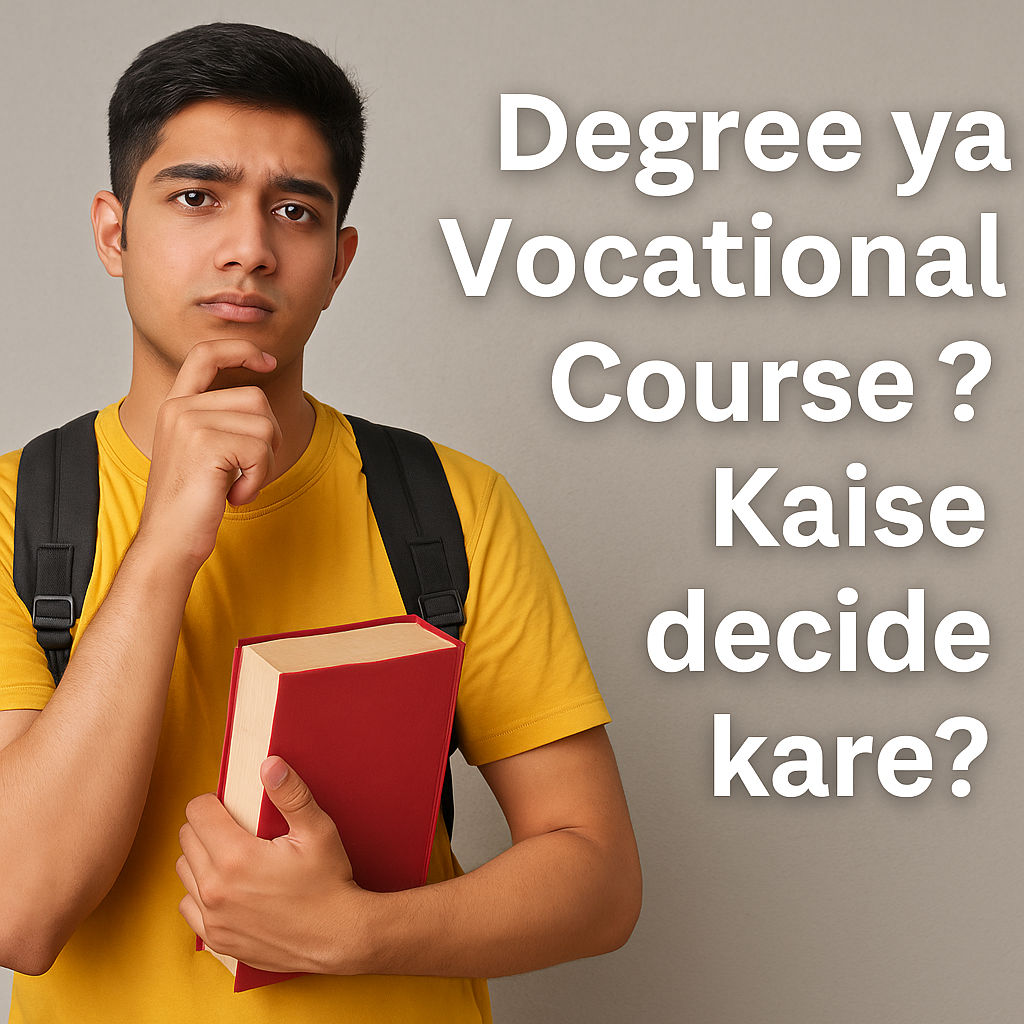
Introduction: Degree ya Vocational Course? Kaise Decide Kare?
Degree ya Vocational Course? Kaise decide kare? Yeh ek aisa sawal hai jo har student aur unke parents ke dimaag mein aata hai jab career planning ka samay hota hai. Kya aap ek traditional degree program ko choose karein jo theoretical knowledge aur long-term career growth ke liye design kiya gaya hai, ya ek vocational course jo practical skills aur jaldi employability par focus karta hai?
Aaj ki duniya mein, career ke liye sahi disha ka chunav karna asaan nahi hai. Is blog mein hum aapko degree aur vocational courses ke pros aur cons, real-world examples, aur salary data ke saath explain karenge. Aapke liye yeh guide banayi gayi hai taki aap ek informed aur future-proof decision le saken. 😊
In this blog, we will explore both options, the pros and cons of each, salary trends, and real-world examples. By the end of this article, you’ll have the insights needed to make an informed decision. And if you need further guidance, Dheya Career Mentoring is here to assist you.
What is a Degree and What is a Vocational Course?
Understanding Degree Programs
A degree program typically spans 3-5 years, offering an academic approach to education. These programs focus on providing theoretical knowledge in specific fields like Engineering, Medicine, Arts, and Business. Degree courses are often offered by universities or colleges, and upon completion, students are awarded a Bachelor’s or Master’s degree.
Popular Degree Programs in India:
B.Tech (Engineering)
BBA (Business Administration)
MBBS (Medicine)
BA/MA (Arts)
LLB (Law)
Degree programs are ideal for those who wish to pursue a professional career in specific sectors that require in-depth knowledge and a structured educational pathway.
Understanding Vocational Courses
On the other hand, vocational courses focus on skill-based learning and practical training. These courses are typically shorter (1-2 years) and aim to equip students with the necessary skills to start a career immediately after completion.
Examples of Popular Vocational Courses:
Web Development
Electrician
Plumbing
Hotel Management
Culinary Arts
Graphic Designing
Vocational courses are great for students who want to gain job-specific skills quickly and enter the workforce without spending years in formal education.
Pros and Cons of Degree Programs vs. Vocational Courses
Advantages of a Degree Program
Higher Earning Potential: Degree holders generally have access to higher-paying jobs with more opportunities for growth.
Career Progression: A degree can offer long-term career stability and potential promotions in various fields.
Recognition: A degree from a reputed university carries significant prestige and can open doors to top-level positions.
Real-World Example:
Engineers, doctors, and lawyers are prime examples of degree holders with higher earnings. For instance, an engineering graduate can earn anywhere between ₹6,00,000 to ₹12,00,000 per year, depending on the field and industry.
Disadvantages of a Degree Program
Higher Cost: Degree programs can be expensive, especially in private institutions. The cost of education, including tuition fees, books, and living expenses, can accumulate significantly.
Long Duration: A degree typically takes 3-5 years to complete, which might not be ideal for those eager to start their careers.
Uncertainty in Job Market: While degrees provide theoretical knowledge, finding a job can be challenging if the field is saturated or if there’s a lack of job-ready skills.
Advantages of Vocational Courses
Shorter Duration: Vocational courses typically take less time to complete, allowing students to enter the job market sooner.
Affordable: These courses are generally more affordable than traditional degree programs, reducing the financial burden.
Practical Skills: Vocational courses focus on providing hands-on training and job-specific skills that are highly valued by employers.
Real-World Example:
Skilled workers in fields like IT support, plumbing, or hospitality can start earning ₹3,00,000 to ₹5,00,000 annually, depending on their expertise.
Disadvantages of Vocational Courses
Limited Career Progression: Vocational courses may limit opportunities for advancement in certain industries as they do not always offer a path to further academic qualifications.
Less Recognition: Some vocational qualifications are not as widely recognized as university degrees, which may limit career options in the long run.
Key Factors to Consider Before Choosing
Your Career Goals and Aspirations
The most important factor in deciding between a degree and a vocational course is your career goal. If you dream of becoming an engineer, doctor, or lawyer, a degree is the most suitable option. However, if you aspire to work in sectors like IT support, hospitality, or trades, a vocational course can get you started quickly.
Examples:
A tech enthusiast may pursue a degree in computer science, while someone passionate about cooking may opt for a culinary arts course.
Financial and Time Constraints
Cost of Education: Degree programs, especially in private colleges, can cost anywhere between ₹2,00,000 to ₹10,00,000 for the entire course. On the other hand, vocational courses can cost between ₹50,000 and ₹1,50,000, depending on the field.
Duration: Degree programs take 3-5 years, while vocational courses can range from 6 months to 2 years.
Comparison Table:
Program Duration Average Cost (INR)
Degree Program 3-5 years ₹2,00,000+
Vocational Course 6 months-2 years ₹50,000-1,50,000
Industry Demand and Job Opportunities
The job market is increasingly looking for skilled professionals. While degree holders are essential for fields requiring theoretical knowledge, vocational courses offer an edge in fields like IT, healthcare, and manufacturing.
Emerging Career Fields:
IT Support and Web Development are rapidly growing sectors that prefer skill-based professionals.
Electricians and Plumbers are also in high demand due to the increase in infrastructure projects across India.
Salary Insights: Degree vs. Vocational Training
Salary Trends for Degree Holders
Degree holders generally enjoy higher salaries. For example:
Engineering: ₹6,00,000 – ₹12,00,000 annually.
Medicine: ₹8,00,000 – ₹20,00,000 annually.
Law: ₹5,00,000 – ₹12,00,000 annually.
Salary Table for Degree Holders:
Field Average Salary (INR)
Engineering ₹6,00,000+
Medicine ₹12,00,000+
Law ₹5,00,000+
Salary Trends for Vocational Course Graduates
Vocational course graduates may not earn as much as degree holders, but the gap is narrowing, especially in high-demand fields. For example:
IT Support: ₹4,00,000 annually.
Electrician: ₹2,50,000 – ₹4,00,000 annually.
Hospitality: ₹3,00,000 annually.
Salary Table for Vocational Course Graduates:
Field Average Salary (INR)
IT Support ₹4,00,000
Electrician ₹2,50,000
Hospitality ₹3,00,000
Real-World Success Stories and Case Studies
Success Stories of Degree Holders
Professionals who pursued a degree program have found success in various fields. For example:
Sundar Pichai (CEO of Google) completed his B.Tech in Metallurgical Engineering, leading him to one of the top positions in the tech world.
Success Stories of Vocational Course Graduates
Several successful entrepreneurs started their careers with vocational courses. For instance:
Vikas Khanna, a world-renowned chef, began his career with a culinary arts course and eventually built a global restaurant empire.
How Dheya Career Mentoring Can Help
At Dheya Career Mentoring, we understand the complexity of making such decisions. Our expert mentors will guide you through this process with personalized counseling and career assessments, helping you determine the best educational path for your career goals.
Personalized Guidance based on your interests and strengths.
Industry Insights and future career trends.
Actionable Steps to pursue the right course or degree.
Visit www.dheya.com to get expert career guidance today!
Conclusion: Make an Informed Decision
In conclusion, deciding between a degree ya vocational course is a critical step in shaping your career. Whether you opt for a degree or a vocational course depends on your career aspirations, financial situation, and the time you’re willing to invest. It’s essential to align your education with your long-term goals to ensure success.
If you’re still uncertain, Dheya Career Mentoring can help you make the right decision, offering personalized career guidance and mentoring. Don’t let indecision hold you back—take the next step toward a successful career today!